A friend had been trying to get me interested in Battlefield 3 for a while. It was only after finding that I had some Nectar points to spend that I decided to buy it. Having said that it’s only £25.
At first I had no idea what I was doing, but assistance from the same friend helped out. He’s often online when I’m playing and we group together (a shame he has a rubbish headset, though).
I recently mentioned I was searching for a new desktop PC. In particular, I’m looking for a small form-factor PC that will sit, quite literally, on my desktop. It needs to be reasonable powerful and quiet. At the time too I mentioned it was difficult to find such PCs, without having to build one yourself. However, I’ve now come across 7 and I just wanted to provide details on each and where, I think, they’re lacking. I haven’t used any of these, I should add, so this is not a review!
Back in May the PC Pro team discussed, on their podcast, the (then) upcoming ICO cookie regulations. However, as is often the case, they got so lost in the idea that big websites can easily do this kind of work they missed the point that this would cause issues for smaller website owners, who may not have the necessary skillset to provide the solutions that the ICO wanted.
Darien Graham-Smith appeared to be the most vocal so I emailed him, putting forward my views. Rather than respond to me I’ve found my email, modified, appearing in the letters page of the latest PC Pro magazine. With this letter they’ve not put any kind of reply to so I still have no idea whether they support my ascertions or not.
Here, then, I’ve published the original email…
Hi Dr Graham-Smith,
I’ve been listening to the latest PC Pro podcast and wanted to add something to your discussion about the ICO legislation changes.
I run a modest website (20k+ monthly views, earns me some reasonable pocket money on top of a day job, I’m sure you understand the kind of thing). The ICO changes, as they were, were literally causing me sleepless nights and I don’t think I was alone.
What I think you missed in your conversation is that we’re not all big companies with developers on-tap to provide the solution that the ICO wants. There are probably a lot more owners of modest websites than there are “PC Pro’s” of this world.
My site is a self hosted WordPress installation. As such it was my responsibility to implement the ICO changes. However, a developer I may be but that doesn’t mean I know everything about everything and cookies “aren’t my thing”. Instead, like thousands of other self-install WordPress users alone, I was reliant on some clever soul providing a plugin to do what was needed. Unfortunately, it didn’t happen (I wrote a review of what was available in case you’re interested – https://artiss.blog/2012/05/how-to-get-your-wordpress-site-ready-for-the-ico-cookie-regulations).
In the case of WordPress most cookies are generated by third parties or by plugins. In the case of the latter any scripts are added by the plugins. As suppressing cookies invariably means modifying the scripts that output them, this would have meant updating other people’s plugins. Then when the plugin is updated our changes are lost. All of this requires a level of knowledge that most WordPress owners wouldn’t have anyway. The only solution that WAS available to such owners before their change of heart on Friday was a pop-up that only allowed you to view the site if you accepted cookies – I wouldn’t allow this approach on my site and would rather have incurred the wrath of the ICO in preference. Therefore I approached the weekend with no solution that met the ICO criteria.
So, to find the rules relaxes was an absolute god-send. I can now implement a thorough cookie policy, highlighted at the top of the site and can list the cookies used by the site. I don’t have to offer any opt-out or make any scary code changes. Of course that will take me a few days in my occasional spare time which is why I’m equally glad the ICO aren’t chasing people too keenly.
If these last minute changes hadn’t been made I suspect a LOT of websites would not have met the ICO criteria any time soon and the whole thing would have un-policable as a result.
The thing is, though, after everything I said I believe the original solution was the best one for the consumer. However, if the EU are going to introduce some laws would it have been beyond them to have provided tools and software so that site owners could have easily provided a single, easy solution? As it was, each person that did implement something did it in their own (often unique) way – how many hours of time was wasted on everyone trying to achieve the same thing?
If you’ve somehow missed it (it’s hard to do so) a number of UK papers, along with the MP Claire Perry, are leading a converted push to get the government to bring in legislation to require ISPs to add network-level filters to block adult content. In particular they are promoting the filter system used by TalkTalk.
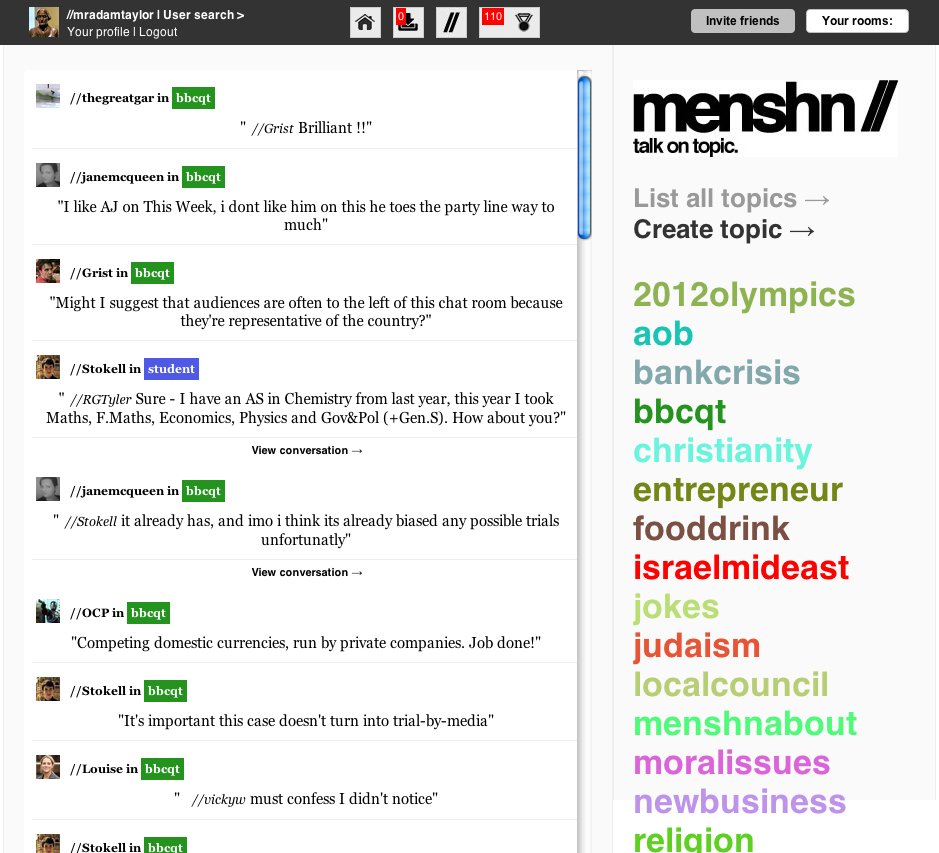
Menshn is a new social networking site, kind of like Twitter but on specific, allocated subjects.
It’s recently had prominence for 2 reasons – one of the creators of the site is UK Tory MP Louise Mensch and when initially launched they were transmitting user name and passwords in plain text (not good).
So, after a bit of a disastrous start, I thought I’d check out the site. Unfortunately, it wasn’t that easy.