
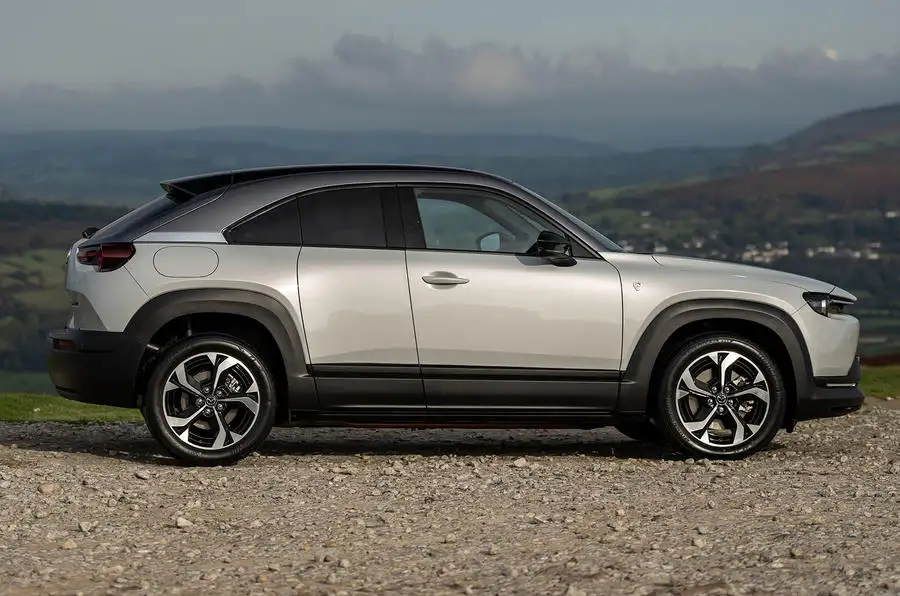
I was due to replace my car early next year, and I’ve been looking at plug-in hybrids (PHEV). The cost and range anxiety of a full EV was always something that put me off, which is why the PHEV was the perfect solution.
I’d been looking for a while, online, at the options but was dismayed at the high costs or, where it wasn’t so expensive, the massive compromise.
And then I came across the recently released Mazda MX-30 R-EV. I went for a test drive, read the reviews and, days later, bought one. Why now? They have some fantastic offers, inc. a big chuck off the price.
So, how’s it gone?
The engine
Unlike most hybrids, it doesn’t switch between petrol and electric engines to drive the wheels, but uses EV entirely for this and the battery range is a lot bigger than rivals – up to 50 miles. Instead, the MX-30 has a small 800cc engine that it uses as a generator, topping up the battery as needed. In my case, where most of my journeys are small, I’ll use it fully in EV mode and charge up at home overnight.
Oh, and that petrol engine – it’s a rotary engine (and just a single rotor too). Yes, Mazda have bought back their legendary rotary engine for this car.


Why the Mazda?
Check reviews and many people are saying the same thing – “it’s the best plug-in hybrid you can buy”. It’s also one of the cheapest, if not the cheapest. The quality of the interior is second-to-none.


It’s also very nice to drive too (both are things that Mazda prides itself on).
The downsides? It has “suicide doors” at the back, which are cropped, so you have to get into the back similarly to a 3-door. Also the handles are on the inside of the door, so the front door has to be open to open or close the rear. Also, room in the back isn’t great. For me, most of the time, there’s nobody in the back. Or, if there is, one small person.
Is it worth passing on an otherwise superb car because of the configuration of the rear doors? I’d say not.
Also, and minor, is that Mazda (like other manufacturers, it has to be noted) kinda forgets about the rear seat passengers. My Puma had some netting on the rear of the front seats for storage and a USB socket in the middle binnacle, but the Mazda has none of these. All the USB sockets are in the front of the car, so charging in the rear isn’t possible (not without a really long USB cable anyway). There is, however, a middle arm rest with cup holders. So phone charging and storage, no, cups, yes.
But, making up for this in a little way is the fact that the front of the car and the boot also have a full 3-pin mains socket!
My first day
I picked the car up yesterday, in the morning. The Derby dealership was voted the best Mazda dealer a couple of years ago, and it shows – they’ve been very attentive and helpful.
I had the car presented to me in the showroom, under a black cloth, with a velvet rope around it. A nice touch.

It’s the top-of-the-range Makoto model, with the ceramic colour. Mazda do such a lovely red, but I’m not spending £1800 for it! The ceramic looks white or silver depending on the lights and looks fantastic.
In the boot of the car you’ll find 3 things…
- Charging cables
- A bag for the cables
- An oil kit
The later is because the rotary engine does use up quite a bit of oil during it’s early life, so this allows you to top up if you can’t easily get to a dealer – otherwise, they’ll do it for you for free.
Screens
Mazda hates touch screens. And so they should. Using them whilst driving is such a safety issue, and yet more and more manufacurers are adding them, often in preference to physical buttons.
The main screen, used for controlling SatNav and media, is not a touch screen. It’s operated by a controller in the centre console. It’s a bit more fiddly when using Apple CarPlay or Google Auto, but if that’s the pay-out for greater safety then I’m all for it.
In front of the automatic gear stick, at the front of the floating centre console, is the only touch screen, which is solely for the climate control (inc. heated seats and steering wheel). However, all the main functions are duplicated on buttons around the outside.
Finally, the screen in front of the steering wheel is a hybrid – digital content but within fixed borders. So you have the traditional, physical dials, but the displays within them are digital.
Can I also say, although not a touch screen, the heads-up display, which projects directly onto the windscreen (it looks like it’s floating at the very end of the bonnet) is superb. One of the things I missed after I got rid of the Mazda 3 (although that used the method of projecting it onto a piece of glass on top of the dashboard).
Charging up
Before the car even turned up, I had the option to have an EV charger installed at home. One of Mazda’s other offers was for half price chargers from Pod Point. Now, EV chargers add value to your house, so getting one for half price seemed an opportunity not to miss. Don’t get me wrong, the Mazda MX-30 R-EV doesn’t need such a charger – it can just be plugged into a standard mains sockets – but for a quick splash-and-dash it seemed an ideal opportunity.
Pod Point get you to submit a questionnaire, photos and videos online and will use that to decide if installation is possible. If so, they then arrange an installer – mine turned up the next day, but this is unusual (he just happened to be in the area – normally, it’s a few days before installation). The end result is neat and generally easy to use. I went for the more expensive version with the captive cable.
I have experienced one minor niggle (although I understand why it does what it does). You schedule charging via their app – I have Economy 7, so I get cheap electric between midnight and 7am. However, if it looses Wi-Fi connection and the charging cable is in the car, it will start straight away, so you don’t potentially go to get in the car, expecting it to be charged up, and finding it’s not. And this is what happened to me yesterday, when I got a notification on my phone to say the car was charging, hours before it should have been.
Pod Point should, ideally, make the scheduling local, so it’s pushed from the app to the device – that way if the Wi-Fi goes off it can stick to its stored schedule.
For now, if it becomes an issue, the car itself can schedule the charging, so I can see the Pod Point to be on at all times and let the car take it over (which doesn’t require a Wi-Fi connection).
But, back to the charging – there’s a type-2 fast charger as well as a CCS, so you have choices. The former will be used at home, other via a home charger, such as the one I have, or plugging into a standard mains socket. Cables for both are provided with the car.
Whilst I’ll be charging the car mostly at home, I’m interested in the idea of doing it on my travels as well, but have yet to work out at what point commercial charges are cheaper/more expensive than using petrol. They’re a lot more than my overnight electricity prices (often 4 times more), so I feel that it may sometimes be worth me using the generator rather than charging away from home. At some point I need to wrap my head around the maths.
The Mazda app
I’ve not had a chance to use it fully yet but the Mazda app seems excellent – I can check the status of the doors, lock/unlock them, even start the car and run the heating and clear the windows in advance of getting in it.
And, of course, you can status information about the car from it, including charging. This includes push notifications, so I always know when charging has started, stopped, etc. (and why I knew about the above Pod Point issue as well!).
The manual
The provided manual, although detailed, doesn’t always give a “why” to things. For example, I wanted to try out the EV acceleration so floored it and… the engine cut in. Whilst in the full EV mode. It took me a while but in the manual it says this will happen – if you push the accelerator fully down the engine may come in. But it doesn’t say “why”. I guess it doesn’t need to but the curious, it’s nice to understand the context of it.
Also, the manual assumes you know Mazda’s names for things. When I wanted to learn more about the speed limiter (or speed restrictor, as many would call it), I came up empty. No, Mazda has their own term and they expect you to know it – the index doesn’t contain synonyms, which would have been more useful.
That’s it so far. I haven’t done a long trip yet (a couple are coming up in the coming days, though), so haven’t even tested out the generator yet, but further thoughts will come along later. For now, the Mazda is rather superb and well worth a look if a plug-in hybrid is something you’re considering.
 Share this post on social media.
Leave a Reply